

It was a perfect summer day when Casey Kays first climbed to Sunfish Pond.
On Sunday, August 13, 1961, he hiked the Appalachian Trail to the mountaintop lake four miles northeast of the Delaware Water Gap, carrying picnic supplies, a camera, and no idea that the place would take over his life.
“Something happened to me that day,” Kays recalled. “I was just overcome with the natural beauty of the area. I actually fell in love with the lake and the mountain.”
The plan was simple: a family picnic on a sunny weekend day. It certainly did not include changing the course of New Jersey’s fight over its wild areas.
Kays could not have known that months earlier, this natural gem on public land had been sold off to power companies.
Until then, Kays had only heard about Sunfish Pond from his father, George R. Kays, a retired railroad engineer from Washington, New Jersey. His dad had fished the pond as a teenager more than 50 years earlier, catching pumpkinseed sunfish in the summer and ice fishing for yellow perch in the winter.
The sunfish and perch that George Kays fished, along with chain pickerel and brown bullheads, are among the few hardy species that can tolerate the naturally acidic lake. With a pH between 4.0 and 4.3 — similar to tomato juice — the acidity is a result of the lake’s bedrock. Water passing over pyrites-bearing rock produces sulfuric acid, while decomposing plants in surrounding bogs release organic acids that drain into the lake; unlike bedrock in other areas, the Shawangunk Formation’s quartzite and conglomerate offer little buffering against either.
By inhibiting the growth of plants and limiting the number of animal species, the acidity also contributes to the striking clarity of the lake.
The clarity must have captivated Casey that day.

Born on September 20, 1923 just a few miles south of Sunfish Pond in the Knowlton Township hamlet of Polkville, Casey Kays was one of four children of George and Ida Mae Best Kays. He graduated in June 1941 from Washington High School, where he wrestled and played baseball. Four months after the attack on Pearl Harbor, he enrolled in the U.S. Navy Radio School at the University of Wisconsin-Madison, which trained 15,000 radiomen over the next 3 and a half years. Kays served in the invasion of southern France during World War II as a Navy first-class radioman — the highest enlisted radioman rating. He left active duty on September 24, 1945.
The war “made a very deep impression on him,” recalled his daughter, who noted that as a radioman, he was reading the reports on the war as they were coming in.
Kays was not a lawyer, politician, or scientist. He was a working man from Warren County. He worked as a textile printer for Castle Creek and lived in Hackettstown most of his life. By the time his life became consumed with saving this small mountaintop lake, he was working as a custodian at the Hoffmann-La Roche Belvidere plant.
Within a few years of falling in love with Sunfish Pond, Kays had two full-time jobs: one the IRS cared about, and another as one of the most effective conservationists in the state’s history.
That was still a few years away.
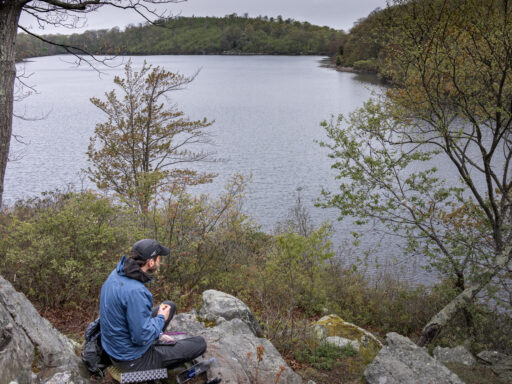
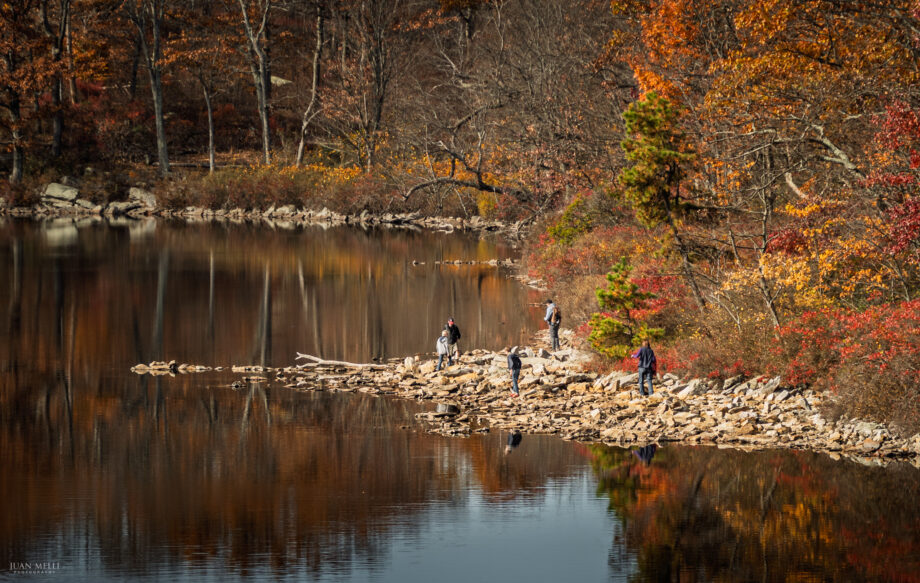
As Casey and his family approached Sunfish Pond via the Appalachian Trail, they would have first reached the southwestern end of the lake. Sheltered from the wind on three sides, the shallow tip of the pond can lie still enough to form a mirror, reflecting the round forested ridges to the northeast and clouds above.
From there, the trail crosses the lake’s outflow at a natural rock weir that maintains Sunfish Pond’s constant elevation of 1,379 feet, with the overflow beginning a 1,000-foot descent into the Delaware River near Labar Island. The trail then passes a broad rocky beach before bending southeast near today’s junction with the Turquoise Trail. Near that junction, a small rise on the eastern edge of the lake offers a rocky resting place and a commanding view across the water.

Casey and his family had walked only a few miles. A north-bound thru-hiker starting in Georgia walks 1,300 miles before reaching Sunfish Pond — the southernmost glacial lake on the entire trail.
The mountains around the lake are ancient. The Appalachian chain — including the Kittatinny Ridge the lake sits upon —formed hundreds of millions of years ago and may once have matched the modern Andes in height, worn to rounded ridges by eons of erosion.
Sunfish Pond, perched atop this ridge, is by comparison a geological infant.
During the last ice age, the late Wisconsinian Glacier reached its maximum extent just 2 miles south of the Delaware Water Gap, burying Kittatinny Mountain in ice. As the glacier retreated northward around 13,000 BC, it scoured a 60-foot-deep bowl into the top of the ridge. Water filled it. Sunfish Pond was born.
As the climate warmed, tundra gave way to spruce and pine, and eventually, by about 8000 BC, to deciduous forest.
It took the forces of nature millennia to create this natural wonder — a deep, clear lake, improbably perched atop a mountain.
Casey Kays would soon learn it had all been signed away with the stroke of a pen.
Discover more from From My Perspective
Subscribe to get the latest posts sent to your email.