
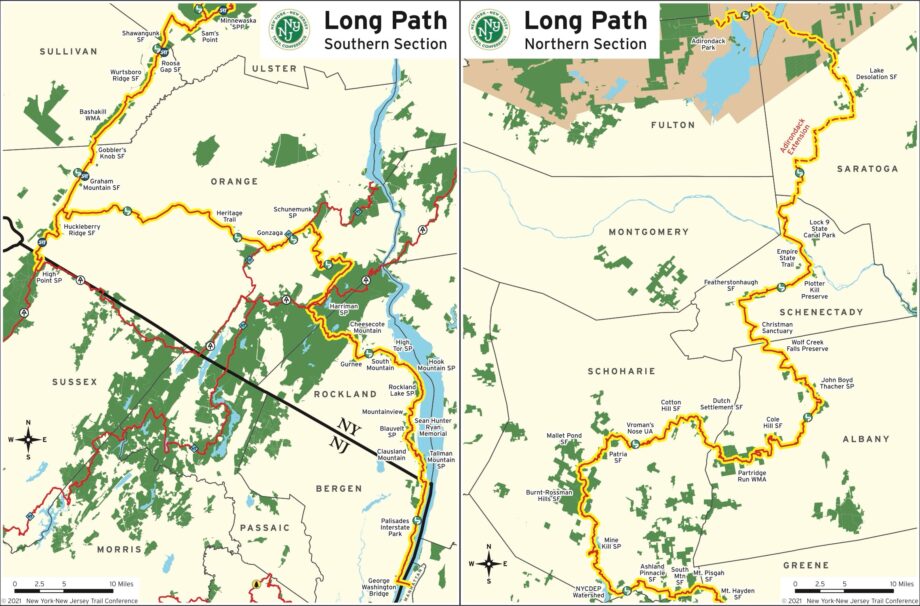
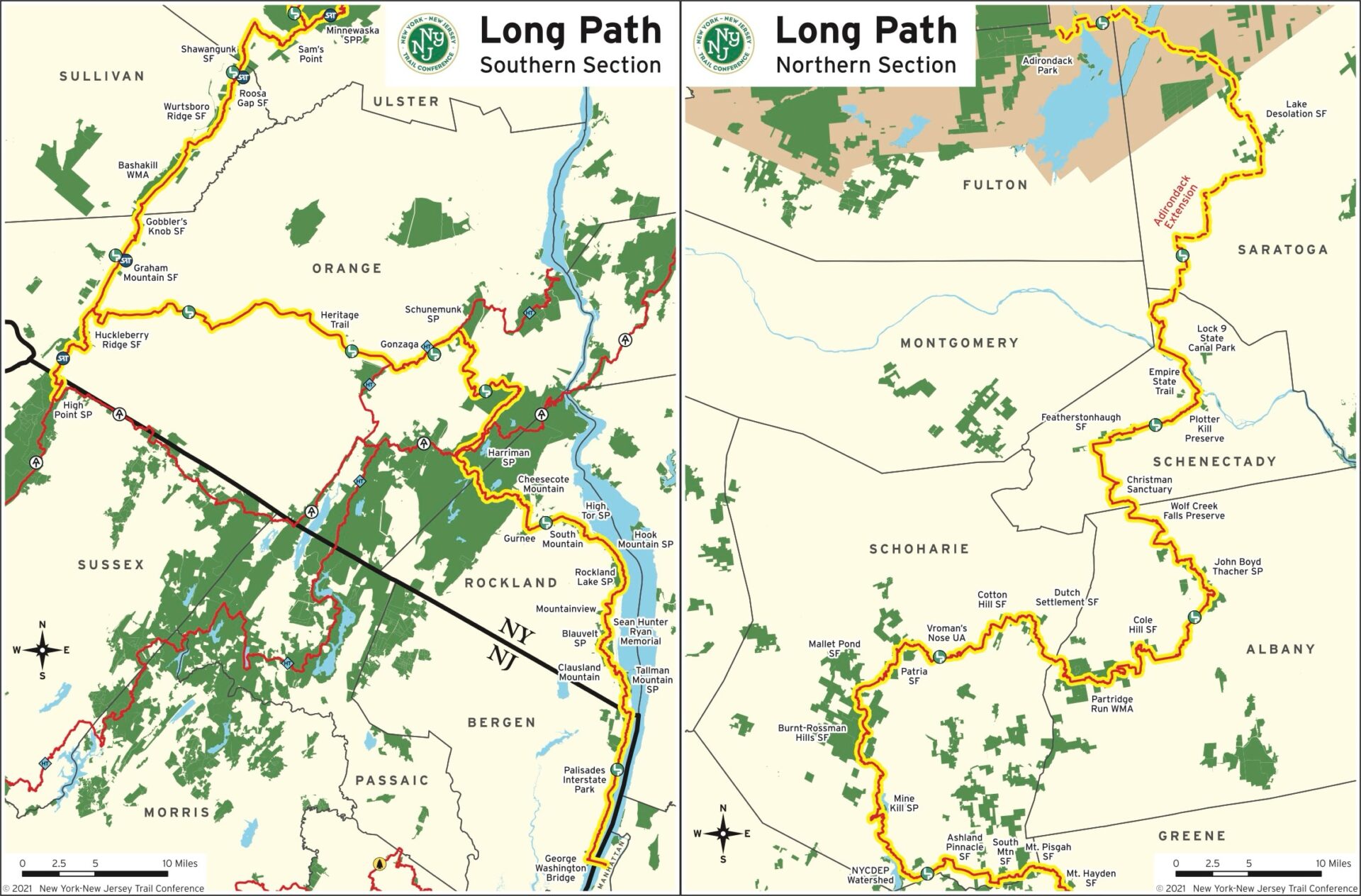
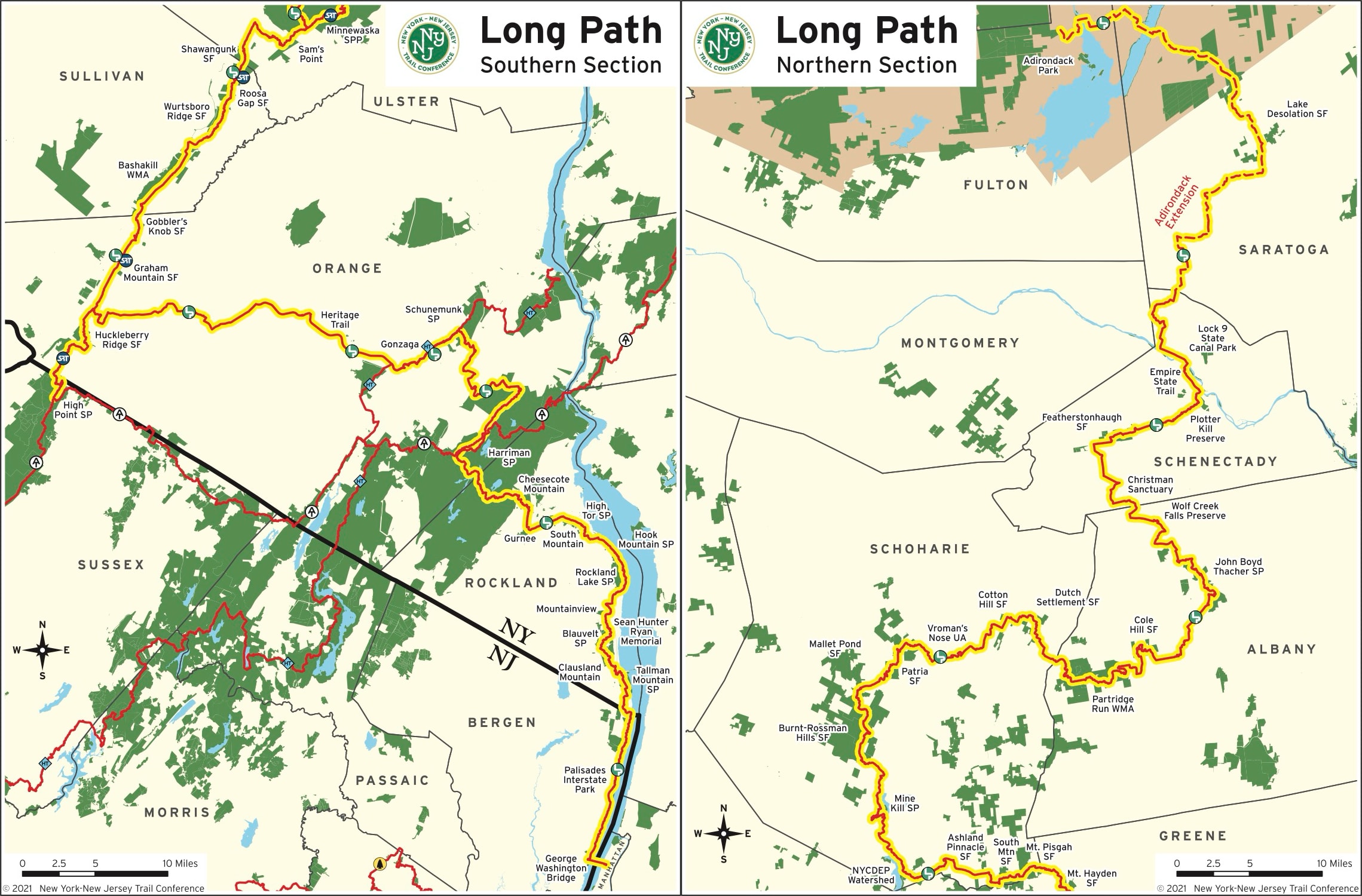
Commuters step off the A train at 175th Street in Washington Heights every day without realizing they are standing at one of the most unusual trailheads in the country. There is no sign to mark it, no plaque, no blaze. Yet from this subway station begins the Long Path, a 358-mile trail that leads from New York City to the foothills of the Adirondacks.
Afoot and light-hearted I take to the open road,
Healthy, free, the world before me,
The long brown path before me leading wherever I choose.Song of the Open Road, Walt Whitman
A Brief History of a Long Path
The trail — still a work in progress — has evolved both as an idea and in its physical form.
First proposed in 1931 by Paul and Vincent Schaefer of the Mohawk Valley Hiking Club as New York’s answer to Vermont’s Long Trail, the concept was for an unmarked route from New York City to Lake Placid in the Adirondacks. Since the 1920s, Raymond H. Torrey, a founder of the New York-New Jersey Trail Conference, had been writing a weekly New York Post column titled “The Long Brown Path,” inspired by the reference in Walt Whitman’s “Song of the Open Road.” Starting in 1933, Torrey’s column championed the Schaefers’ “Long Path of New York,” featuring descriptions of sections of the route in his Tuesday columns. However, an unmarked route was a difficult concept for the public to grasp, and interest in the route waned after World War II and remained dormant for the next 20 years.
The idea was revived in 1960 by Robert Jessen and Michael Warren, two members of the Ramapo Ramblers — this time as a marked trail from the George Washington Bridge to Mount Whiteface in the Adirondacks. Over the years, sections of trail have been identified, acquired, built, blazed, and sometimes rerouted. The southern and northern termini have changed.
As of 1987, the trail was 216 miles long over 23 sections, growing to 236 miles and 25 sections by 1992, and 358 miles and 35 sections today. A current priority is to eliminate as many of the 60 miles of road walks as possible, work that is actively underway.
For over 50 years, work on the trail has been led by the New York-New Jersey Trail Conference, a volunteer-based organization that builds and maintains 2,000+ miles of trails across New York and New Jersey. Print guides for the Long Path were published in 1982, 1987, 1992, 1997, and 2002, however the Trail Conference now maintains an online guide for the trail. There’s also a helpful Friends of the Long Path Facebook group.
Becoming an “End to Ender”
The New York–New Jersey Trail Conference provides official End-to-End certification to hikers who complete the Long Path, whether as a continuous thru-hike or over time in sections. A tally sheet is available to track progress along the route.
The first known End-to-Ender was Albert “Cap” Field, who completed the trail on an unknown date. The first completion with a recorded date was by Ed Walsh, who finished on July 4, 1991.
Since then, the number of completions has steadily grown. There were 59 in the 1990s, 52 in the 2000s, and 67 in the 2010s. The pace appears to be accelerating further in recent years. During the pandemic-era hiking boom, 23 hikers completed the Long Path in 2021.
The largest group finish occurred on October 9, 2005, when 13 hikers completed the trail on the same day. Today the roster of Long Path End-to-Enders has grown to more than 230 hikers, illustrating the trail’s evolution from a little-known regional route to a recognized long-distance challenge.
Discover more from From My Perspective
Subscribe to get the latest posts sent to your email.